2023 Joint Nakba and Israeli-Palestinian Memorial Day Ceremonies
Nonviolence International is pleased to announce we will be co-sponsoring the American Friends of Combatants for Peace's 2023 Joint Nakba Day Ceremony and Israeli-Palestinian Joint Memorial Day Ceremony.
This event is more important now than ever before. Join the largest Israeli-Palestinian peace event in history. On April 24, 2023, we will gather to call for peace, freedom, and human rights for all. The Joint Israeli-Palestinian Memorial Day Ceremony is hosted by Combatants for Peace and The Parents Circle–Families Forum.
Register Here!
Yom Hazikaron, Israel’s Memorial Day, is a solemn day on which Israelis remember those they have lost in the years of war and conflict. Traditionally, the Palestinian narrative is erased. The Joint Memorial Day Ceremony is different. It provides a unique opportunity for Israelis and Palestinians to grieve and heal together. In mourning side by side, we seek not to equate narratives but to transform despair into hope and build bridges of deep compassion that can change reality. By unifying our pain and longing for peace, we demonstrate to the world our power to co-create a safe and free future.

Please see below a message from NVI founder Mubarak Awad
Thank you for your interest in the Combatants for Peace memorial event. This page lists several things you can do to help build a better future.
First, I want to ask you to feel free to be in touch with me with your ideas and suggested action steps. None of us have all the answers, but together our collective wisdom is strong. Please contact me here.
There are two books that can help guide us forward. Jonathan Kuttab wrote Beyond the Two-State Solution to spark a new conversation about the future of both our people and the region as a whole. I ask that you read this book, share it with others, and invite Jonathan to speak with groups you think would be interested in helping us break out of the unsustainable status-quo. Get your free copy here.
Creative nonviolence is always evolving and growing. So we are launching Michael Beer’s book along with an interactive database of nonviolent tactics. This database celebrates our collective wisdom and our capacity to come together - in the face of massive challenges - and find powerful nonviolent ways to protest and to help build the new emerging world.
We know that effective nonviolence doesn’t just happen, but is enhanced by both knowledge of tactics and training. Please see our nonviolence training archive developed in partnership with Rutgers University International Institute for Peace
We hope you will be inspired by these books and our online tools. Please use these tools to come up with creative, constructive nonviolent actions and let us know what you are doing so we can spread the inspiration to others.
If you believe, as I do, that the world needs to learn about the power of nonviolence, please consider helping us build the organization I founded and have given much of my life to - Nonviolence International. If you can make a gift to support this work, please do so here.
16th Israeli-Palestinian Memorial Day Ceremony (2021)
Below, please see the full ceremony. Mubarak is introduced at 56:50.
See also the video below featuring Sami Awad.
Latest posts

Update from global volunteers in Istanbul on April 20th including
Ann Wright, Huwaida Arraf, Dr. John Reuwer, Lisa Fithian, Wynd Kaufmyn, Cassandra Nixon and Shabnam Mayet. All hosted by NVI Palestinian leaders, Mubarak Awad, and Sami Awad
Update from Ann Wright, April 15, 2024
Here is a beautiful Instagram that updates the world about the upcoming flotilla. Volunteers are coming from more than 30 countries!
Media Release
April 4, 2024
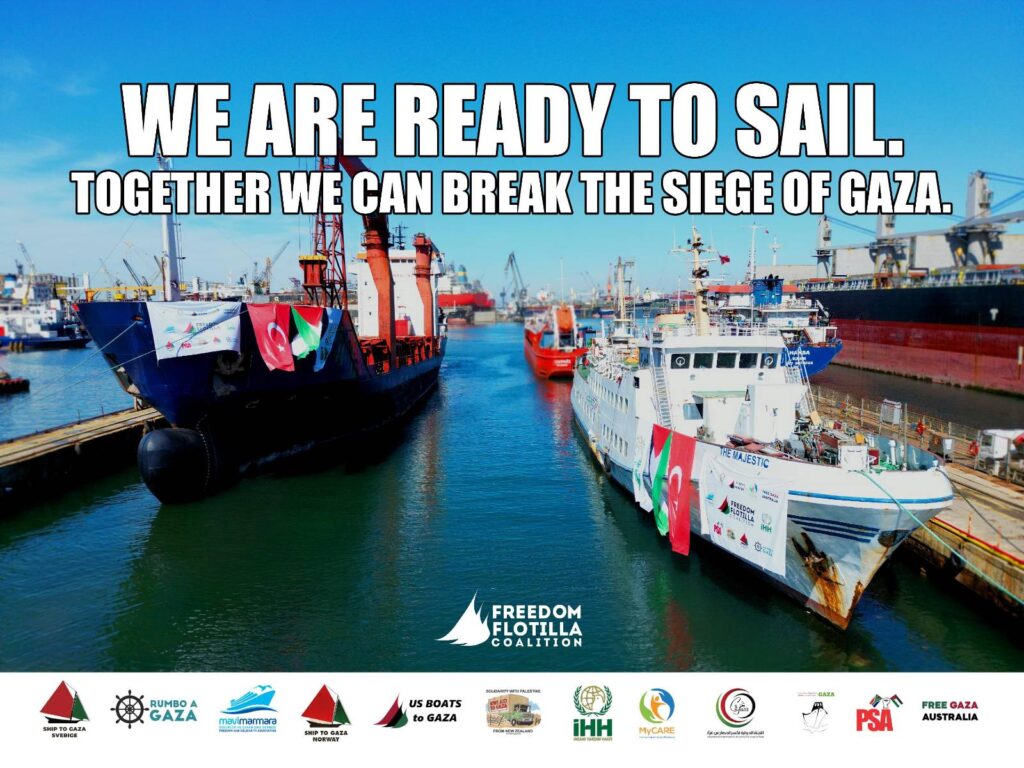
The international Freedom Flotilla Coalition (FFC) will sail in mid April with multiple vessels, carrying 5500 tons of humanitarian aid and hundreds of international human rights observers to challenge the ongoing illegal Israeli blockade of the Gaza Strip. This is an emergency mission as the situation in Gaza is dire, with famine setting in in northern Gaza, and catastrophic hunger present throughout the Gaza Strip as the result of a deliberate policy by the Israeli government to starve the Palestinian people. Time is critical as experts predict that hunger and disease could claim more lives than have been killed in the bombing.
Getting humanitarian aid to Palestinians in Gaza is urgent, but it is not sufficient. We must end Israel’s unlawful, deadly blockade as well as Israel’s overall control of Gaza. Allowing Israel to control what and how much humanitarian aid can get to Palestinians in Gaza is like letting the fox manage the henhouse. And yet, this is what the international community of states is allowing by refusing to sanction Israel and defy its genocidal policies in order to ensure that enough aid reaches the trapped, beleaguered and bombarded civilian population.
The Cyprus maritime corridor, the U.S. floating pier project, and symbolic air drops of food are all distractions from the fact that these methods of aid delivery are insufficient, and still leave Israel in control of what aid can get to the Palestinian people, all while Israel actively prevents thousands of aid trucks from entering Gaza through the land crossings.
On January 26 the International Court of Justice ruled that, ‘the State of Israel remains bound to fully comply with its obligations under the Genocide Convention and with the said Order, including by ensuring the safety and security of the Palestinians in the Gaza Strip.’ On March 28, the ICJ ordered additional preliminary measures, which included requiring the Israeli forces to stop “preventing, through any action, the delivery of urgently needed humanitarian assistance” to Palestinians in Gaza.
Israel has long violated its responsibility as occupying power to ensure the health and wellbeing of Palestinians in Gaza and the West Bank. Now, it is engaging in full scale genocidal conduct in Gaza and using starvation as a weapon of war. Israeli military and political leaders have repeatedly declared their intention to collectively punish the entire population of Gaza, including by denying them food, water and other life-sustaining aid. We therefore reject Israel’s control over the humanitarian aid that can enter Gaza and reject any Israeli inspection of our cargo.For everyone’s safety and to ensure aid is delivered to those who need it, the FFC is bringing hundreds of international humanitarian observers, from many countries and different backgrounds.
“The International Court of Justice’s preliminary measures ordered against Israel are very clear” comments Ismail Moola of South Africa’s Palestine Solidarity Alliance, part of the Freedom Flotilla Coalition. “The court’s ruling requires the whole world to play their part to stop the genocide unfolding in Gaza, including unobstructed access to vital aid. While our governments fail to lead in these urgently required humanitarian responses, people of conscience and our grassroots organizations must act to take leadership. When governments fail, we sail!”
###
Many supporters of Nonviolence International are joining this aid effort as volunteers.
If you want to donate, please donate here.
(Please see this page for background information, resources, and action steps on Palestine / Israel)
NVI fiscally sponsors groups that work to help Gazans. Please support them.
If you want to hear news and views directly from Gaza, please check the website and social media sites of We Are Not Numbers.
US Boats to Gaza is a member of the global Freedom Flotilla Coalition. They seek to bring humanitarian aid by sea to Gaza and break the siege. Learn more about their important work below.
Here are some photos from the big recent Washington, DC event for Palestinian humanity that was part of much larger global effort.
Don't miss this important event!
In this time of enormous unnecessary suffering, it is vitally important that people of good will everywhere raise up the humanity of Palestinian people.
NVI is grateful to the co-founder of our wonderful fiscally sponsored partner, We Are Not Numbers, Ahmed Alnaouq, who brought this short moving video clip to our attention.
Don’t miss US Representative Rashida Tlaib saying the name and last words of WANN writer, Yousef Dawas.
Then take a moment to watch her powerful video here.
We Are Not Numbers is featured in this moving piece in "In These Times."
“I yearn for our voices to echo across the globe with the truth, reaching out to those who seek it.”
SHERELL BARBEE FEBRUARY 7, 2024
https://inthesetimes.com/article/letters-from-gaza-genocide-palestine-culture-
We are thrilled that Ahmed's powerful voice was included in the Washington Post.
Here is his excerpt and a link (behind a paywall) to the full article, which includes other perspectives - several not rooted in personal experience or basic human compassion for the suffering of others. When militarists are welcomed into the mainstream press, the media doesn't feel a need to provide "balance." But, for some reason, the few times that Palestinian voices are heard, they present another perspective that often negates Palestinian humanity.
The slaughter must end
Ahmed Alnaouq: Last week, Israel bombed my family home in Gaza, killing my father, as well as two brothers, three sisters and all of their children, in an instant. One friend described their bodies as “bags of meat” — an arm here, a leg there.
I write to you in mourning. Even now, we Palestinians are not granted the luxury to grieve. Instead, we are burdened with the responsibility to talk, to communicate the extent of our suffering and the injustice wielded against us.
So, first, I must say this: We demand an immediate cease-fire. We demand a lifting of the Israeli siege of Gaza and the restoration of electricity, fuel, water and food. And we demand unimpeded humanitarian access in line with international law.
Today, the word “genocide” is being widely used. I can’t think of another word that captures the magnitude of what Israel, a nuclear-armed military power, continues to unleash on a captive population of children and refugees. Israeli Defense Minister Yoav Gallant said the quiet part out loud: “Gaza won’t return to what it was before,” he said. “We will eliminate everything.”
But we Palestinians already knew what Gallant had in mind. Corralled in Gaza for the past 17 years, burdened with mass unemployment and poverty — even before white phosphorus filled the skies, or before we lay crushed beneath the rubble — we could not breathe. We were held captive like prisoners who had never committed a crime or shot down when we attempted to peacefully protest our incarceration.
Our 1 million children have never traveled outside Israel’s militarized cage and know nothing but the buzz of drones in the sky tracking their every move.
In the past week, I have lost everything. But I do not seek revenge. There is no “military solution” here, only a collective responsibility to finally grant Palestinians what they have demanded for decades, what they are owed: justice, freedom and their very basic rights as human beings.
Ahmed Alnaouq is the head of We Are Not Numbers, which pairs Palestinian writers with mentors overseas.
https://www.washingtonpost.com/opinions/2023/11/02/gaza-ceasefire-civilian-military-humanitarian/
Click here to donate to support NVI's fiscally sponsored partner WANN.
Ahmed was also featured in this recent New York Times piece.
After the Israeli military killed his older brother in an airstrike in Gaza in 2014, Ahmed Alnaouq says, he almost lost his will to live. “I sank into a deep depression,” he told me in a recent phone call. But an American friend convinced him to write about his brother and channel his grief into something productive. Together, they founded We Are Not Numbers, a project that trains young writers in Gaza and publishes their personal essays in English.
The name is a nod to how numbing numbers can be. The higher the death toll, the less we are inclined to care, since the scale of human suffering can feel overwhelming. Statistics don’t trigger empathy and action. Personal stories do.
“This project changed my life because for the first time, I thought that some people can care about us,” Mr. Alnaouq said, describing the response it got outside Gaza.
We Are Not Numbers began as a way to memorialize the dead, but it quickly turned into a lifeline for the living. For young people in Gaza, stuck in a political system with few rights and a blockaded economy with few jobs, it provides a vital outlet for self-expression...
“After losing my family, I did not stop believing in what I believe in,” he told me. “I don’t want other people to feel what I am feeling. Not the Israelis, not the Palestinians.”
These very painful, honest, meaningful videos feature WANN's co-founder.
Trigger / harsh reality warning.
Mubarak Awad speaks on KKFI radio about Palestine
Moussa Elbayoumy, Yara Salamed, and NVI President Mubarak Awad discuss calls for a ceasefire in the current Israel-Hamas war. Moussa is an MD and chair of the board of the Kansas chapter of the Council on American-Islamic Relations (CAIR-Kansas). Yara is studying Law at UMKC and is President of Students for Justice in Palestine there. Mubarak is a Palestinian born in Jerusalem in 1943, influenced by Mennonite and Quaker missionaries. He received bachelors, masters and PhD degrees from universities in the US. He became a US citizen in 1978 and returned to Jerusalem in 1983 to found the Palestinian Centre for the Study of Nonviolence. He was expelled from Palestine in 1988 during the First Intifada for organizing nonviolent protests against mistreatment of Palestinians by Israeli military and settlers. Back in the US, he founded Nonviolence International. Moussa, Yara and Mubarak are calling for a ceasefire in the current Israel-Gaza war. KKFI.ORG
Sadly, this short NVI video clip from two years ago is still relevant.
Refaat Alareer, WANN's co-founder, killing featured in major media outlets.
In this episode of Mondoweiss’s podcast Culture Editor Mohammed El-Kurd
speaks with journalist and co-founder of We Are Not Numbers Ahmad Alnaouq.
Michael Beer quoted in LA Times article on effective activism.
Please see these articles:
Writing while expecting to die “Can you kindly publish the attached stories if I die?” This is what we have been hearing from the young writers we work with from Gaza in the We Are Not Numbers project.
7 steps to end the cycle of violence in Israel and Palestine:
The path to peace requires nonviolent action not just from Israelis and Palestinians, but also Americans, the media, aid organizations and others.
By NVI Founder, Mubarak Awad. We are pleased to announce this piece was selected as Waging Nonviolence's top story of the year! https://wagingnonviolence.org/2023/12/waging-nonviolence-top-stories-2023/
When will we learn that violence doesn’t lead to security?
To support Israelis and Palestinians is to insist on their right to equally live in peace and freedom — not help structures of state violence and cultures of militarization.
By NVI Board member, Mohammed Abu-Nimer
Solidarity with Palestinians and Jews Sign on Statement.
By Jonathan Kuttab, NVI co-founder. Cat Zavis, Jewish Civil/Women's Rights Lawyer, Mediator, and Rabbi: Beyt Tikkun. Michael Lerner, Rabbi and Editor of Tikkun magazine.
Esther Azar, Arab Jewish Trauma Activist, and Rabbi: Trauma Informed Rabbinics.
Recent attacks by Israel on Gaza and Hamas fighters on Israel are tragic and will not resolve bring peace and justice to all.
NVI believes that nonviolence is the only way to end the savagery, brutality and cycle of violence between Palestinians and Israelis.
NVI urges all parties to cease all military attacks and prevent further escalation of violence that will only harm innocent civilians on both sides.
Call for an immediate ceasefire and end to all violence, including an immediate halt to attacks towards Israel and Israeli military attacks on Gaza.
Urgent humanitarian action is needed, including the establishment of a humanitarian corridor inside and out of Gaza, for the safe movement of people and the delivery of essential supplies. This includes opening Erez and Kerem Shalom / Abu Salem crossings to allow for the movement of people and goods and remove the ban on access to the sea.
End violations of international law and impunity, including settlement expansions, forcible transfer, demolitions, settler violence, all part of ongoing and illegal de facto annexation of West Bank territory. Immediately lift all movement restrictions on Palestinian communities in the West Bank to allow the movements of goods and services.
Take action at the UN Security Council to reaffirm UN Security Council resolutions calling for a nonviolent resolution of disputes, the reversal of the annexation of Greater East Jerusalem and the preservation of the status quo at holy sites.
NVI supports nonviolent political resolution of the conflict by ending the systemic policies of oppression and discrimination of Palestinians, including the 16-year siege on Gaza and 56-year military occupation of the Occupied Palestinian Territory, including. East Jerusalem.
We hope you will find this helpful and will share it with others.
US Boats to Gaza is a fiscally sponsored partner of NVI and a member of the global Freedom Flotilla Coalition. They seek to bring humanitarian aid by sea to Gaza and break the siege. Learn more below.
In this video, Ann Wright, a leader of US Boats to Gaza, Veterans for Peace, and Code Pink interrupts the US Secretary of State to call for a Cease Fire Now. Timestamp 1:45
Check out this powerful video (from before the latest crisis), learn more about their important work, and please consider supporting this creative constructive nonviolent movement.

Don't miss this important event!
https://youtube.com/live/BaLaRo73BLU
Join us on our youtube live channel, Youtube/nonviolence to watch this discussion of activist leaders on global solidarity and resistance for justice in Palestine.
(Please see this page for background information, resources, and action steps on Palestine / Israel)
NVI fiscally sponsors groups that work to help Gazans. Please support them.
If you want to hear news and views directly from Gaza, please check the website and social media sites of We Are Not Numbers.
US Boats to Gaza is a member of the global Freedom Flotilla Coalition. They seek to bring humanitarian aid by sea to Gaza and break the siege. Learn more about their important work below.
Here are some photos from the big recent Washington, DC event for Palestinian humanity that was part of much larger global effort.
In this time of enormous unnecessary suffering, it is vitally important that people of good will everywhere raise up the humanity of Palestinian people.
NVI is grateful to the co-founder of our wonderful fiscally sponsored partner, We Are Not Numbers, Ahmed Alnaouq, who brought this short moving video clip to our attention.
Don’t miss US Representative Rashida Tlaib saying the name and last words of WANN writer, Yousef Dawas.
Then take a moment to watch her powerful video here.
We Are Not Numbers is featured in this moving piece in "In These Times."
“I yearn for our voices to echo across the globe with the truth, reaching out to those who seek it.”
SHERELL BARBEE FEBRUARY 7, 2024
https://inthesetimes.com/article/letters-from-gaza-genocide-palestine-culture-
We are thrilled that Ahmed's powerful voice was included in the Washington Post.
Here is his excerpt and a link (behind a paywall) to the full article, which includes other perspectives - several not rooted in personal experience or basic human compassion for the suffering of others. When militarists are welcomed into the mainstream press, the media doesn't feel a need to provide "balance." But, for some reason, the few times that Palestinian voices are heard, they present another perspective that often negates Palestinian humanity.
The slaughter must end
Ahmed Alnaouq: Last week, Israel bombed my family home in Gaza, killing my father, as well as two brothers, three sisters and all of their children, in an instant. One friend described their bodies as “bags of meat” — an arm here, a leg there.
I write to you in mourning. Even now, we Palestinians are not granted the luxury to grieve. Instead, we are burdened with the responsibility to talk, to communicate the extent of our suffering and the injustice wielded against us.
So, first, I must say this: We demand an immediate cease-fire. We demand a lifting of the Israeli siege of Gaza and the restoration of electricity, fuel, water and food. And we demand unimpeded humanitarian access in line with international law.
Today, the word “genocide” is being widely used. I can’t think of another word that captures the magnitude of what Israel, a nuclear-armed military power, continues to unleash on a captive population of children and refugees. Israeli Defense Minister Yoav Gallant said the quiet part out loud: “Gaza won’t return to what it was before,” he said. “We will eliminate everything.”
But we Palestinians already knew what Gallant had in mind. Corralled in Gaza for the past 17 years, burdened with mass unemployment and poverty — even before white phosphorus filled the skies, or before we lay crushed beneath the rubble — we could not breathe. We were held captive like prisoners who had never committed a crime or shot down when we attempted to peacefully protest our incarceration.
Our 1 million children have never traveled outside Israel’s militarized cage and know nothing but the buzz of drones in the sky tracking their every move.
In the past week, I have lost everything. But I do not seek revenge. There is no “military solution” here, only a collective responsibility to finally grant Palestinians what they have demanded for decades, what they are owed: justice, freedom and their very basic rights as human beings.
Ahmed Alnaouq is the head of We Are Not Numbers, which pairs Palestinian writers with mentors overseas.
https://www.washingtonpost.com/opinions/2023/11/02/gaza-ceasefire-civilian-military-humanitarian/
Click here to donate to support NVI's fiscally sponsored partner WANN.
Ahmed was also featured in this recent New York Times piece.
After the Israeli military killed his older brother in an airstrike in Gaza in 2014, Ahmed Alnaouq says, he almost lost his will to live. “I sank into a deep depression,” he told me in a recent phone call. But an American friend convinced him to write about his brother and channel his grief into something productive. Together, they founded We Are Not Numbers, a project that trains young writers in Gaza and publishes their personal essays in English.
The name is a nod to how numbing numbers can be. The higher the death toll, the less we are inclined to care, since the scale of human suffering can feel overwhelming. Statistics don’t trigger empathy and action. Personal stories do.
“This project changed my life because for the first time, I thought that some people can care about us,” Mr. Alnaouq said, describing the response it got outside Gaza.
We Are Not Numbers began as a way to memorialize the dead, but it quickly turned into a lifeline for the living. For young people in Gaza, stuck in a political system with few rights and a blockaded economy with few jobs, it provides a vital outlet for self-expression...
“After losing my family, I did not stop believing in what I believe in,” he told me. “I don’t want other people to feel what I am feeling. Not the Israelis, not the Palestinians.”
These very painful, honest, meaningful videos feature WANN's co-founder.
Trigger / harsh reality warning.
Mubarak Awad speaks on KKFI radio about Palestine
Moussa Elbayoumy, Yara Salamed, and NVI President Mubarak Awad discuss calls for a ceasefire in the current Israel-Hamas war. Moussa is an MD and chair of the board of the Kansas chapter of the Council on American-Islamic Relations (CAIR-Kansas). Yara is studying Law at UMKC and is President of Students for Justice in Palestine there. Mubarak is a Palestinian born in Jerusalem in 1943, influenced by Mennonite and Quaker missionaries. He received bachelors, masters and PhD degrees from universities in the US. He became a US citizen in 1978 and returned to Jerusalem in 1983 to found the Palestinian Centre for the Study of Nonviolence. He was expelled from Palestine in 1988 during the First Intifada for organizing nonviolent protests against mistreatment of Palestinians by Israeli military and settlers. Back in the US, he founded Nonviolence International. Moussa, Yara and Mubarak are calling for a ceasefire in the current Israel-Gaza war. KKFI.ORG
Sadly, this short NVI video clip from two years ago is still relevant.
Refaat Alareer, WANN's co-founder, killing featured in major media outlets.
In this episode of Mondoweiss’s podcast Culture Editor Mohammed El-Kurd
speaks with journalist and co-founder of We Are Not Numbers Ahmad Alnaouq.
Michael Beer quoted in LA Times article on effective activism.
Please see these articles:
Writing while expecting to die “Can you kindly publish the attached stories if I die?” This is what we have been hearing from the young writers we work with from Gaza in the We Are Not Numbers project.
7 steps to end the cycle of violence in Israel and Palestine:
The path to peace requires nonviolent action not just from Israelis and Palestinians, but also Americans, the media, aid organizations and others.
By NVI Founder, Mubarak Awad. We are pleased to announce this piece was selected as Waging Nonviolence's top story of the year! https://wagingnonviolence.org/2023/12/waging-nonviolence-top-stories-2023/
When will we learn that violence doesn’t lead to security?
To support Israelis and Palestinians is to insist on their right to equally live in peace and freedom — not help structures of state violence and cultures of militarization.
By NVI Board member, Mohammed Abu-Nimer
Solidarity with Palestinians and Jews Sign on Statement.
By Jonathan Kuttab, NVI co-founder. Cat Zavis, Jewish Civil/Women's Rights Lawyer, Mediator, and Rabbi: Beyt Tikkun. Michael Lerner, Rabbi and Editor of Tikkun magazine.
Esther Azar, Arab Jewish Trauma Activist, and Rabbi: Trauma Informed Rabbinics.
Recent attacks by Israel on Gaza and Hamas fighters on Israel are tragic and will not resolve bring peace and justice to all.
NVI believes that nonviolence is the only way to end the savagery, brutality and cycle of violence between Palestinians and Israelis.
NVI urges all parties to cease all military attacks and prevent further escalation of violence that will only harm innocent civilians on both sides.
Call for an immediate ceasefire and end to all violence, including an immediate halt to attacks towards Israel and Israeli military attacks on Gaza.
Urgent humanitarian action is needed, including the establishment of a humanitarian corridor inside and out of Gaza, for the safe movement of people and the delivery of essential supplies. This includes opening Erez and Kerem Shalom / Abu Salem crossings to allow for the movement of people and goods and remove the ban on access to the sea.
End violations of international law and impunity, including settlement expansions, forcible transfer, demolitions, settler violence, all part of ongoing and illegal de facto annexation of West Bank territory. Immediately lift all movement restrictions on Palestinian communities in the West Bank to allow the movements of goods and services.
Take action at the UN Security Council to reaffirm UN Security Council resolutions calling for a nonviolent resolution of disputes, the reversal of the annexation of Greater East Jerusalem and the preservation of the status quo at holy sites.
NVI supports nonviolent political resolution of the conflict by ending the systemic policies of oppression and discrimination of Palestinians, including the 16-year siege on Gaza and 56-year military occupation of the Occupied Palestinian Territory, including. East Jerusalem.
We hope you will find this helpful and will share it with others.
US Boats to Gaza is a fiscally sponsored partner of NVI and a member of the global Freedom Flotilla Coalition. They seek to bring humanitarian aid by sea to Gaza and break the siege. Learn more below.
In this video, Ann Wright, a leader of US Boats to Gaza, Veterans for Peace, and Code Pink interrupts the US Secretary of State to call for a Cease Fire Now. Timestamp 1:45
Check out this powerful video (from before the latest crisis), learn more about their important work, and please consider supporting this creative constructive nonviolent movement.


Send Aid Not Bombs, March 25-29, 2024
See a map of actions around the USA

For more information check out their website: https://www.mennoniteaction.org/
Donate here.


Mennonite Action Prayer Service For Ceasefire in Gaza in the US Congress on January 16, 2024
Don't miss this prominent and positive coverage in the Washington Post.
https://www.washingtonpost.com/dc-md-va/2024/01/16/gaza-protest-cannon-building-mennonite-action/
We are people of God’s peace.
Mennonite Action is a movement of Mennonites bonded by a common belief that we must be public about our peace values. We believe that Mennonites have a responsibility to use our voices as powerfully as possible for the cause of peace and justice. We are taking public action as Mennonites. We are mobilizing Mennonites across the US and Canada to demand a ceasefire, end the US and western funded occupation of Palestine, and build for lasting peace.

“To be hopeful in bad times is not just foolishly romantic. It is based on the fact that human history is a history not only of cruelty, but also of compassion, sacrifice, courage, kindness...What we choose to emphasize in this complex history will determine our lives. If we see only the worst, it destroys our capacity to do something. If we remember those times and places—and there are so many—where people have behaved magnificently, this gives us the energy to act and at least the possibility of sending this spinning top of a world in a different direction...And if we do act, in however small a way, we don't have to wait for some grand utopian future. The future is an infinite succession of presents and to live now as we think human beings should live, in defiance of all that is bad around us, is itself a marvelous victory." -- Howard Zinn
NVI is proud to be the fiscal sponsor for the this important project. Please consider donating here.


(Please see this page for background information, resources, and action steps on Palestine / Israel)
NVI has helped support the formation of the Philadelphia interfaith group for peace in Gaza named Prayers for Peace Alliance. Check out their new website!
NVI President Mubarak Awad spoke on March 28, 2024, at an interfaith Iftar organized by Prayers for Peace Alliance in Philadelphia.
Please enjoy this inspirational 35 minute speech!
Palestinians and Jews are joining together to invite churches and synagogues to stop the violence in Gaza and work for peace with justice in Palestine/Israel.

Prayers for Peace Alliance co-Coordinater, Sam Kuttab, helping lead the walk by Friends of Combatants for Peace in Chestnut Hill, Philadelphia. USA 25-2-2024
November 19, 2023: Don't miss this powerful article from Daoud Kuttab.
On Sunday Nov. 12, 2023, Palestinian-Americans with support from a Friends of Sabeel North America, If Not Now (Philadelphia Chapter), the Alhidaya Islamic Center, and Nonviolence International handed out leaflets at the Elon Tabernacle Church in Philadelphia asking parishioners to pray for people of Gaza and to call on the US government to support a cease-fire.
Palestinian activists displayed signs which said “I’m a Palestinian American Living in the Community. Every 10 minutes a Child is Killed. Pray for Gaza. Stop the Genocide.” Activists from the Alhidaya Islamic Center and If Not Now along with Activiststood in solidarity. The parishioners universally took the leaflets offered and read them. After 30 minutes, the visitors were invited inside in front of the pulpit where the Reverend Waller, warmly welcomed the Palestinian, Jewish and Islamic visitors and proceeded to pray for them, their families, and the people of Gaza for 10 minutes. He concluded by calling for an immediate ceasefire saying that his congregation does not takes sides, just the sides of peace for the Palestinian and Israeli people.
Given the warm response, NVI and these activist groups will continue to reach out to Philadelphia church-goers to pray for Gaza and support a cease-fire. If you want to get more information, reach out to us at [email protected]
Philadelphians will continue to reach out to other churches on Sunday November 19, 2023. Here is the media release.

Two Palestinian-Americans standing outside of the Elon Tabernacle Church

Delegation members invited inside to Rev Waller's pulpit

Muslims, Christians and Jews standing outside of the Elon Tabernacle Church
NVI fiscally sponsors groups that work to help Gazans. Please support them.
If you want to hear news and views directly from Gaza, please check the website and social media sites of We Are Not Numbers.
US Boats to Gaza is a member of the global Freedom Flotilla Coalition. They seek to bring humanitarian aid by sea to Gaza and break the siege. Learn more about their important work below.
Here are some photos from the big recent Washington, DC event for Palestinian humanity that was part of much larger global effort.