Update from global volunteers in Istanbul on April 20th including
Ann Wright, Huwaida Arraf, Dr. John Reuwer, Lisa Fithian, Wynd Kaufmyn, Cassandra Nixon and Shabnam Mayet. All hosted by NVI Palestinian leaders, Mubarak Awad, and Sami Awad
Update from Ann Wright, April 15, 2024
Here is a beautiful Instagram that updates the world about the upcoming flotilla. Volunteers are coming from more than 30 countries!
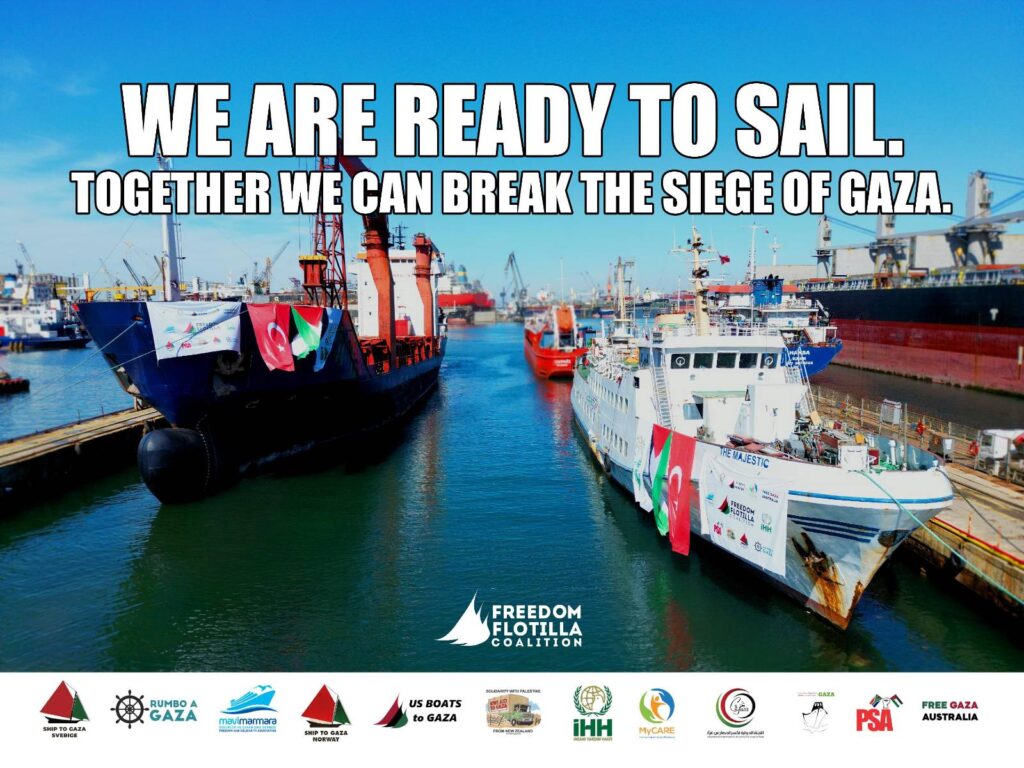
Media Release
April 4, 2024
The international Freedom Flotilla Coalition (FFC) will sail in mid April with multiple vessels, carrying 5500 tons of humanitarian aid and hundreds of international human rights observers to challenge the ongoing illegal Israeli blockade of the Gaza Strip. This is an emergency mission as the situation in Gaza is dire, with famine setting in in northern Gaza, and catastrophic hunger present throughout the Gaza Strip as the result of a deliberate policy by the Israeli government to starve the Palestinian people. Time is critical as experts predict that hunger and disease could claim more lives than have been killed in the bombing.
Getting humanitarian aid to Palestinians in Gaza is urgent, but it is not sufficient. We must end Israel’s unlawful, deadly blockade as well as Israel’s overall control of Gaza. Allowing Israel to control what and how much humanitarian aid can get to Palestinians in Gaza is like letting the fox manage the henhouse. And yet, this is what the international community of states is allowing by refusing to sanction Israel and defy its genocidal policies in order to ensure that enough aid reaches the trapped, beleaguered and bombarded civilian population.
The Cyprus maritime corridor, the U.S. floating pier project, and symbolic air drops of food are all distractions from the fact that these methods of aid delivery are insufficient, and still leave Israel in control of what aid can get to the Palestinian people, all while Israel actively prevents thousands of aid trucks from entering Gaza through the land crossings.
On January 26 the International Court of Justice ruled that, ‘the State of Israel remains bound to fully comply with its obligations under the Genocide Convention and with the said Order, including by ensuring the safety and security of the Palestinians in the Gaza Strip.’ On March 28, the ICJ ordered additional preliminary measures, which included requiring the Israeli forces to stop “preventing, through any action, the delivery of urgently needed humanitarian assistance” to Palestinians in Gaza.
Israel has long violated its responsibility as occupying power to ensure the health and wellbeing of Palestinians in Gaza and the West Bank. Now, it is engaging in full scale genocidal conduct in Gaza and using starvation as a weapon of war. Israeli military and political leaders have repeatedly declared their intention to collectively punish the entire population of Gaza, including by denying them food, water and other life-sustaining aid. We therefore reject Israel’s control over the humanitarian aid that can enter Gaza and reject any Israeli inspection of our cargo.For everyone’s safety and to ensure aid is delivered to those who need it, the FFC is bringing hundreds of international humanitarian observers, from many countries and different backgrounds.
“The International Court of Justice’s preliminary measures ordered against Israel are very clear” comments Ismail Moola of South Africa’s Palestine Solidarity Alliance, part of the Freedom Flotilla Coalition. “The court’s ruling requires the whole world to play their part to stop the genocide unfolding in Gaza, including unobstructed access to vital aid. While our governments fail to lead in these urgently required humanitarian responses, people of conscience and our grassroots organizations must act to take leadership. When governments fail, we sail!”
###
Many supporters of Nonviolence International are joining this aid effort as volunteers.
If you want to donate, please donate here.
(Please see this page for background information, resources, and action steps on Palestine / Israel)
NVI fiscally sponsors groups that work to help Gazans. Please support them.
If you want to hear news and views directly from Gaza, please check the website and social media sites of We Are Not Numbers.
US Boats to Gaza is a member of the global Freedom Flotilla Coalition. They seek to bring humanitarian aid by sea to Gaza and break the siege. Learn more about their important work below.
Here are some photos from the big recent Washington, DC event for Palestinian humanity that was part of much larger global effort.
Don't miss this important event!
In this time of enormous unnecessary suffering, it is vitally important that people of good will everywhere raise up the humanity of Palestinian people.
NVI is grateful to the co-founder of our wonderful fiscally sponsored partner, We Are Not Numbers, Ahmed Alnaouq, who brought this short moving video clip to our attention.
Don’t miss US Representative Rashida Tlaib saying the name and last words of WANN writer, Yousef Dawas.
Then take a moment to watch her powerful video here.
We Are Not Numbers is featured in this moving piece in "In These Times."
“I yearn for our voices to echo across the globe with the truth, reaching out to those who seek it.”
SHERELL BARBEE FEBRUARY 7, 2024
https://inthesetimes.com/article/letters-from-gaza-genocide-palestine-culture-
We are thrilled that Ahmed's powerful voice was included in the Washington Post.
Here is his excerpt and a link (behind a paywall) to the full article, which includes other perspectives - several not rooted in personal experience or basic human compassion for the suffering of others. When militarists are welcomed into the mainstream press, the media doesn't feel a need to provide "balance." But, for some reason, the few times that Palestinian voices are heard, they present another perspective that often negates Palestinian humanity.
The slaughter must end
Ahmed Alnaouq: Last week, Israel bombed my family home in Gaza, killing my father, as well as two brothers, three sisters and all of their children, in an instant. One friend described their bodies as “bags of meat” — an arm here, a leg there.
I write to you in mourning. Even now, we Palestinians are not granted the luxury to grieve. Instead, we are burdened with the responsibility to talk, to communicate the extent of our suffering and the injustice wielded against us.
So, first, I must say this: We demand an immediate cease-fire. We demand a lifting of the Israeli siege of Gaza and the restoration of electricity, fuel, water and food. And we demand unimpeded humanitarian access in line with international law.
Today, the word “genocide” is being widely used. I can’t think of another word that captures the magnitude of what Israel, a nuclear-armed military power, continues to unleash on a captive population of children and refugees. Israeli Defense Minister Yoav Gallant said the quiet part out loud: “Gaza won’t return to what it was before,” he said. “We will eliminate everything.”
But we Palestinians already knew what Gallant had in mind. Corralled in Gaza for the past 17 years, burdened with mass unemployment and poverty — even before white phosphorus filled the skies, or before we lay crushed beneath the rubble — we could not breathe. We were held captive like prisoners who had never committed a crime or shot down when we attempted to peacefully protest our incarceration.
Our 1 million children have never traveled outside Israel’s militarized cage and know nothing but the buzz of drones in the sky tracking their every move.
In the past week, I have lost everything. But I do not seek revenge. There is no “military solution” here, only a collective responsibility to finally grant Palestinians what they have demanded for decades, what they are owed: justice, freedom and their very basic rights as human beings.
Ahmed Alnaouq is the head of We Are Not Numbers, which pairs Palestinian writers with mentors overseas.
https://www.washingtonpost.com/opinions/2023/11/02/gaza-ceasefire-civilian-military-humanitarian/
Click here to donate to support NVI's fiscally sponsored partner WANN.
Ahmed was also featured in this recent New York Times piece.
After the Israeli military killed his older brother in an airstrike in Gaza in 2014, Ahmed Alnaouq says, he almost lost his will to live. “I sank into a deep depression,” he told me in a recent phone call. But an American friend convinced him to write about his brother and channel his grief into something productive. Together, they founded We Are Not Numbers, a project that trains young writers in Gaza and publishes their personal essays in English.
The name is a nod to how numbing numbers can be. The higher the death toll, the less we are inclined to care, since the scale of human suffering can feel overwhelming. Statistics don’t trigger empathy and action. Personal stories do.
“This project changed my life because for the first time, I thought that some people can care about us,” Mr. Alnaouq said, describing the response it got outside Gaza.
We Are Not Numbers began as a way to memorialize the dead, but it quickly turned into a lifeline for the living. For young people in Gaza, stuck in a political system with few rights and a blockaded economy with few jobs, it provides a vital outlet for self-expression...
“After losing my family, I did not stop believing in what I believe in,” he told me. “I don’t want other people to feel what I am feeling. Not the Israelis, not the Palestinians.”
These very painful, honest, meaningful videos feature WANN's co-founder.
Trigger / harsh reality warning.
Mubarak Awad speaks on KKFI radio about Palestine
Moussa Elbayoumy, Yara Salamed, and NVI President Mubarak Awad discuss calls for a ceasefire in the current Israel-Hamas war. Moussa is an MD and chair of the board of the Kansas chapter of the Council on American-Islamic Relations (CAIR-Kansas). Yara is studying Law at UMKC and is President of Students for Justice in Palestine there. Mubarak is a Palestinian born in Jerusalem in 1943, influenced by Mennonite and Quaker missionaries. He received bachelors, masters and PhD degrees from universities in the US. He became a US citizen in 1978 and returned to Jerusalem in 1983 to found the Palestinian Centre for the Study of Nonviolence. He was expelled from Palestine in 1988 during the First Intifada for organizing nonviolent protests against mistreatment of Palestinians by Israeli military and settlers. Back in the US, he founded Nonviolence International. Moussa, Yara and Mubarak are calling for a ceasefire in the current Israel-Gaza war. KKFI.ORG
Sadly, this short NVI video clip from two years ago is still relevant.
Refaat Alareer, WANN's co-founder, killing featured in major media outlets.
In this episode of Mondoweiss’s podcast Culture Editor Mohammed El-Kurd
speaks with journalist and co-founder of We Are Not Numbers Ahmad Alnaouq.
Michael Beer quoted in LA Times article on effective activism.
Please see these articles:
Writing while expecting to die “Can you kindly publish the attached stories if I die?” This is what we have been hearing from the young writers we work with from Gaza in the We Are Not Numbers project.
7 steps to end the cycle of violence in Israel and Palestine:
The path to peace requires nonviolent action not just from Israelis and Palestinians, but also Americans, the media, aid organizations and others.
By NVI Founder, Mubarak Awad. We are pleased to announce this piece was selected as Waging Nonviolence's top story of the year! https://wagingnonviolence.org/2023/12/waging-nonviolence-top-stories-2023/
When will we learn that violence doesn’t lead to security?
To support Israelis and Palestinians is to insist on their right to equally live in peace and freedom — not help structures of state violence and cultures of militarization.
By NVI Board member, Mohammed Abu-Nimer
Solidarity with Palestinians and Jews Sign on Statement.
By Jonathan Kuttab, NVI co-founder. Cat Zavis, Jewish Civil/Women's Rights Lawyer, Mediator, and Rabbi: Beyt Tikkun. Michael Lerner, Rabbi and Editor of Tikkun magazine.
Esther Azar, Arab Jewish Trauma Activist, and Rabbi: Trauma Informed Rabbinics.
Recent attacks by Israel on Gaza and Hamas fighters on Israel are tragic and will not resolve bring peace and justice to all.
NVI believes that nonviolence is the only way to end the savagery, brutality and cycle of violence between Palestinians and Israelis.
NVI urges all parties to cease all military attacks and prevent further escalation of violence that will only harm innocent civilians on both sides.
Call for an immediate ceasefire and end to all violence, including an immediate halt to attacks towards Israel and Israeli military attacks on Gaza.
Urgent humanitarian action is needed, including the establishment of a humanitarian corridor inside and out of Gaza, for the safe movement of people and the delivery of essential supplies. This includes opening Erez and Kerem Shalom / Abu Salem crossings to allow for the movement of people and goods and remove the ban on access to the sea.
End violations of international law and impunity, including settlement expansions, forcible transfer, demolitions, settler violence, all part of ongoing and illegal de facto annexation of West Bank territory. Immediately lift all movement restrictions on Palestinian communities in the West Bank to allow the movements of goods and services.
Take action at the UN Security Council to reaffirm UN Security Council resolutions calling for a nonviolent resolution of disputes, the reversal of the annexation of Greater East Jerusalem and the preservation of the status quo at holy sites.
NVI supports nonviolent political resolution of the conflict by ending the systemic policies of oppression and discrimination of Palestinians, including the 16-year siege on Gaza and 56-year military occupation of the Occupied Palestinian Territory, including. East Jerusalem.
We hope you will find this helpful and will share it with others.
US Boats to Gaza is a fiscally sponsored partner of NVI and a member of the global Freedom Flotilla Coalition. They seek to bring humanitarian aid by sea to Gaza and break the siege. Learn more below.
In this video, Ann Wright, a leader of US Boats to Gaza, Veterans for Peace, and Code Pink interrupts the US Secretary of State to call for a Cease Fire Now. Timestamp 1:45
Check out this powerful video (from before the latest crisis), learn more about their important work, and please consider supporting this creative constructive nonviolent movement.
Latest posts
The Power of the Powerless:
Nonviolent Resistance Begins with Ordinary Acts
In the midst of cascading global crises - war, repression, climate breakdown, and democratic backsliding, the world briefly paused this week to listen to Canada’s prime minister’s speech at the World Economic Forum, in Davos. Mark Carney opened his speech with an unexpected story: The Power of the Powerless.
The reference comes from a 1978 essay by Czech dissident and playwright Václav Havel, who would later become president of Czechoslovakia. It remains one of the most important texts on authoritarianism and nonviolent resistance. What makes his analysis enduring is not simply its critique of repression, but its clarity in explaining a question many people still struggle to articulate: why do authoritarian systems persist even when few genuinely believe in them? Havel’s answer is both unsettling and empowering: because society participates in the lie, not necessarily out of conviction, but out of habit, fear, and self-preservation.
Authoritarianism is sustained not only by force, but by conformity. Authoritarian regimes are often imagined as systems held together exclusively by violence, and Havel does not deny the role of coercion, but he argues that the more efficient form of control is subtler: fear that becomes routine. Such systems function because millions of ordinary people quietly adjust their behavior to what is expected of them and, over time, this compliance becomes normalized. People learn how to perform loyalty without believing it. In this sense, authoritarian power depends less on ideological devotion and more on daily participation in a collective performance. This is what Havel calls “living within the lie.”
One of the essay’s most famous examples is that of a greengrocer who places a political slogan in his shop window, written “Workers of the world, unite!” The key point is not the slogan itself, but why it is displayed. The greengrocer does not post it because he believes in it. He does so to signal that he understands the rules of the game. The sign becomes a silent message: I am obedient. I will not cause trouble.
Here, Havel exposes a fundamental weakness of authoritarian systems: they rely on these visible rituals of submission. Such gestures reassure the regime and society that everyone is still playing their assigned role. So Havel asks a deceptively simple question: What happens if the greengrocer removes the sign? He does not topple the regime. But some things do change:
- the ritual is broken
- the illusion of consensus cracks
- the system’s dependence on performance becomes visible
And once that happens, others begin to see that the system is not inevitable.
“Living in truth” as Nonviolent Action
For Havel, the real power of the “powerless” lies in choosing to “live in truth.” This is not a moral slogan, but a practical decision to stop reproducing messages one does not believe, to refuse participation in the lie that sustains the system. These acts may appear small. That is precisely why they are powerful. Nonviolent resistance does not always begin with mass protests or dramatic confrontation. Often, it begins with:
- a worker who refuses to repeat propaganda
- a teacher who teaches honestly
- an artist who creates despite censorship
- a journalist who documents reality
- a neighbor who protects another
- a community that organizes itself
To live in truth is a form of nonviolent direct action - one that interrupts automatic obedience. When ordinary people withdraw their participation from the daily theater of obedience, slogans lose their power, fear loses its monopoly, silence no longer signals consent, and truth begins to circulate again. From a nonviolent perspective, political change often emerges not as a clash of force, but as a crisis of obedience.
Why The Power of the Powerless Matters Today
Havel also points toward a strategy deeply aligned with contemporary nonviolent movements: the creation of parallel structures: spaces of social, cultural, and civic life that exist beyond the regime’s control. Rather than waiting for a single moment of rupture, these initiatives build long-term resilience:
- independent cultural spaces
- community networks
- alternative education
- solidarity economies
- independent media
- civil society organizations
Often, repression does not arrive only as open violence, it appears as normalization: cynicism, self-censorship, isolation, and the belief that “nothing can be done.” Havel’s essay offers a crucial reminder:
Power does not reside only at the top.
Power is embedded in daily life.
And so is the possibility of change.
When people choose to live in truth, they create the conditions authoritarian systems fear most: a society that begins to recognize its own agency. Havel shows that obedience has mechanisms. So does resistance.
Nonviolence, in practice, is the collective refusal to sustain a lie as a form of governance.
It is the patient reconstruction of public life through truth, solidarity, and dignity.
History does not change only when people seize institutions. Often, it changes when people decide, together, to stop performing for power.
Dear friend,
This year we invite you to re-read Dr. King’s Nobel Peace Prize acceptance speech, (or you can watch it on here).
“I conclude that this award which I receive on behalf of that movement is a profound recognition that nonviolence is the answer to the crucial political and moral question of our time – the need for man to overcome oppression and violence without resorting to violence and oppression…. we will know that we are living in the creative turmoil of a genuine civilization struggling to be born…I refuse to accept the cynical notion that nation after nation must spiral down a militaristic stairway into the hell of thermonuclear destruction. I believe that unarmed truth and unconditional love will have the final word in reality.”
Despite making much progress in alleviating racism, sexism and reducing global poverty, we see violence and injustice growing in wars and occupations that destroy civilian life, in places like Palestine, Sudan, Western Sahara, Burma, Ukraine, Uganda, and the Congo. The world has surpassed 100 million refugees, as militarism and war have accelerated.
We see governments across the world suppress dissent and weaken human rights in the name of “security.” Racialized police violence continues. Mass incarceration that destroys communities. Economic inequality is growing while basic needs go unmet. Voting rights are under attack. Protest is criminalized. Migrants are treated as threats rather than human beings.
In the United States, the home of Dr. King, the US government is abetting genocide, attacking constitutional and international laws and institutions, and throwing the world over the cliff into climate chaos, all for the sake of transferring vast wealth and power to the few.
Nonviolence International exists because we refuse to accept this as normal.
Nonviolence is harder than violence. We are not going to kill or threaten our way to a just and sustainable future. We must use persuasion, nonviolent coercion, the rule of law, global cooperation and governance in order to survive and thrive. And we must bring on board the huge segments of humanity who succumb to greed and cruelty and elect abusive leaders out of fear or coercion.
Nonviolence is a way of resisting violence without becoming it.
It is organized, courageous, and disciplined. It is about telling the truth, confronting power, and standing with those who are most impacted.
Dr. King understood that nonviolence demands commitment. It demands action. And it demands a willingness to be uncomfortable for the sake of justice.
Following Dr. King’s example, we ask you to write or video record your own speech on nonviolence! You can write for the world, but we ask that you do it to your kids, your community, and/or your country and in your native language.
We will help you publish it on our website or tag / collaborate us on Instagram and Facebook!
The arc of the moral universe does not bend by itself. It bends when people choose to act.
Thank you for walking this path with us, today and every day.
In solidarity,
Michael Beer & Sami Awad, Co-Directors
P.S. Register for our upcoming webinar: Beyond Political Illusions: What This Moment Demands of Us, on Jan 21, at 10AM ET / 5PM Jerusalem time. We will have a powerful panel, including Jonathan Kuttab, Huwaida Arraf, and Jeff Halper.
This Webinar on January 21, at 10AM ET and 5PM Jerusalem time, entitled Beyond Political Illusions: What This Moment Demands of Us is a strategic conversation bringing together Jonathan Kuttab, Huwaida Arraf, and Jeff Halper. Building on earlier discussions that focused on NVI’s book “Beyond the Two State Solution” this webinar responds to the current reality of genocide, escalating violence, and deepening impunity across Palestine. Our guests will clarify what international law and moral responsibility require of us now to manifest a new society committed to nonviolence, justice, equality, and the dignity of life. Register here!

Goals:
- Support Jeff Halper’s 1 state campaign
- Encourage worldwide book groups around Jonathan’s book
- Clarify the political reality in Palestine and move beyond dominant political frameworks that have collapsed
- Explore what international law, nonviolent action and moral responsibility require of individuals and movements
- Challenge all the existent political frameworks and question how individuals and movements can actually push for alternative frameworks to be put in action
Nonviolence Must Prevail in Iran
As we write this, the people of Iran are demonstrating in the streets of their cities and towns for the last 3 weeks.. They are calling for change and demanding to be heard, despite the violence they are facing from their own government — the death toll may be over 2000 people. The world needs to understand what is happening and why we must respond with urgency and wisdom.
What Is Happening in Iran?
In late December 2025, shopkeepers in Tehran closed their stores. These were not political radicals,these were ordinary business owners who could no longer survive. The cost of food had risen dramatically, after Iran's currency, the rial, lost nearly half its value in 2025. What began as protests about the economy quickly became something much larger. People across Iran, students, pensioners, young people, merchants, took to the streets. They are now calling not just for economic relief, but for fundamental change in how their country is governed. The protests have spread to at least 185 cities. Demonstrations have erupted on university campuses. The chants in the streets express deep frustration: "Death to the Dictator" and "Neither Gaza nor Lebanon, My Life for Iran."
This is not the first time Iranians have risen up. Many remember the Woman, Life, Freedom protests in 2022 after Mahsa Amini, a 22-year-old woman, died in custody after being arrested for not wearing her hijab "correctly." Those demonstrations were met with brutal force—tear gas, mass arrests, and live ammunition. Hundreds died and thousands were imprisoned, but Iranians now state that the morality police are less visible in many urban areas, and many women are openly foregoing the veil without immediate crackdowns.
But the roots go deeper. For decades, Iranians have lived under a system where one man, the Shah Pahlavi, and then the Religious Supreme Leader Ayatollah Ali Khamenei, holds ultimate power over all major decisions. Elections happen, but real power remains concentrated in an unelected official. Young Iranians, who make up a large portion of the population,see no future for themselves. They watch their government spend money supporting armed groups in other countries while they struggle at home. They see corruption, mismanagement, and their voices ignored.
The government blames Iran's economic problems on international sanctions—restrictions placed on Iran by other countries, particularly the United States. While sanctions have certainly contributed to economic hardship, Iran's leaders have begun to admit that their own governance failures share responsibility. President Masoud Pezeshkian, elected in 2024 on promises of economic reform, acknowledged this reality even as the protests spread.
The Violence We Condemn
We are deeply concerned about active violence from all sides. Some protesters have thrown stones and burned government buildings. Government armed actors have been killed. We understand the rage that drives such actions, but we believe that sustainable democratic change comes through disciplined, nonviolent resistance.
Our greatest concern, however, is the violence perpetrated by the Iranian government. The state possesses a complete monopoly on weapons—guns, tear gas, riot control equipment, and the entire security apparatus. Reports indicate that hundreds of protesters have been killed, many shot at close range with live ammunition. Thousands have been arrested. Iran's attorney general has warned that protesters could face charges carrying the death penalty.
The government has shut down internet access in many areas, cutting Iranians off from the outside world and making it difficult to document what is happening. In 2025, Iran executed at least 1,500 people—the highest number in nearly 40 years—as part of what appears to be a deliberate strategy to instill fear. As adherents to Islam, a religion espousing peace, this violence against your own people is haram and unacceptable.
We call on the US and Israel to stop their attacks and continued threats of bombing and regime change. Some desperate Iranians have unwisely called for foreign armed intervention hoping for some miracle. This is more likely to increase government repression.
International sanctions, particularly those imposed by the United States, have for the most part devastated Iran's economy. These sanctions fall most heavily on ordinary Iranians—the same people now protesting in the streets. Sanctions make food more expensive. They restrict access to medicine. They destroy jobs and opportunities. In effect, the international community is punishing the Iranian people for the actions of a government they did not choose and cannot change through normal democratic means.
What the World Must Do
The United States and the international community must lift economic sanctions on Iran. Sanctions strengthen authoritarian governments by giving them an external enemy to blame, by forcing citizens to depend on the state for survival, and by creating a siege mentality that makes reform more difficult. Lifting sanctions would empower the Iranian people. It would improve their economic conditions and give them breathing room to organize and demand change. It would remove the government's favorite excuse for economic failure. And it would demonstrate that the international community stands with the Iranian people, not against them. A best outcome would be for the US and other nations to pay reparations for unwarranted suffering. The US and the UN should call for and enforce a Nuclear Weapons Free Middle East (West Asia).
A Nonviolent Path Forward
We call on the Iranian government to recognize the legitimate grievances of its people, and to engage in dialogue and compromise rather than violence. When a government responds to peaceful protest with bullets, it reveals its own weakness and desperation.
The best outcome we can envision is a referendum on Iran's constitution and genuinely free elections where Iranians can choose their own path forward. The current constitution concentrates power in the hands of unelected religious authorities. The previous constitution did so with an unelected monarch.
Iranians deserve the opportunity to decide what kind of country they want to live in.
What matters is that the Iranian people are the ones who determine their future. Not foreign governments, not military intervention, not external pressure. The people themselves, through their courage and their commitment to justice. We have witnessed people power transform nations—from the Philippines to Poland to Chile to South Africa. We have seen ordinary citizens, armed only with their conviction and their willingness to stand together, overcome seemingly invincible authoritarian systems. The path is never easy. The cost is often high. But change is possible.
Our Message to the People of Iran
You are not alone. The world sees you and our courage inspires us. Your determination to build a better future for yourselves and your children gives us hope.
As part of developing any nonviolent strategy in any situation, certain issues are important to take into account. We urge you to remain disciplined in your protests. We understand that the government uses violence out of desperation, but we encourage Iranians to continue to use measures that sometimes lowers the violence and in some cases improves effectiveness:
- Protest primarily during the day time.
- Invite all people, including women, elderly and children to participate.
- Support the creation of a national network of Mothers and Families of the Martyrs.
- Video record everything.
- Denounce attacks on mosques or Islam, even though many see that the religion has been corrupted and misused by state power.
- Look to the medical community for emerging and credible alternative leadership.
- Build mutual aid networks
- Use of non-cooperation techniques such as boycotts and merchant strikes.
- Use of tactics dispersed over a large area.
- Build unity with the diaspora in spite of its extreme elements.
Nonviolent resistance is not passive, it is strategic. It builds broader support, both within Iran and internationally. It withdraws support for the pillars of power, particularly if society uses tax resistance and general strikes.We know that many of you are feeling desperate and wanting revenge for the suffering. But feelings and violent revolution without modern weapons will likely not achieve your goals. You are welcome to get more ideas on possible tactics from our catalogue of 346 tactics in our huge global database and also explained in our Farsi language downloadable book, Civil Resistance Tactics of the 21st Century.
To the international community: Do not abandon the Iranian people in their hour of need. Sanctions are not solidarity. Lift the economic restrictions that make their lives harder. Support their right to determine their own future. And make clear that the world is watching how their government responds.
The road ahead for Iran is uncertain. But in the streets of Tehran, Isfahan, Tabriz, and hundreds of other cities, the Iranian people are writing a new chapter in their long history. They are reclaiming their voice and demanding their dignity. They are showing the world that the human spirit cannot be crushed, no matter how heavily the boot presses down.
History will remember this moment. Let us ensure that history records not just the suffering, but the courage. Not just the violence, but the resistance. Not just the crisis, but the possibility of transformation. The people of Iran are crying out for justice. The question is whether the world will listen—and whether we will respond with wisdom, compassion, and solidarity.